DarjeelingHIMALAYAS
Khecheopalri

Pelling, Yuksom & South Sikkim · lake

Khecheopalri

The wishing lake where no leaf is left on the water

Altitude1,700m Nights0–1 BestMar – May · Oct – Dec

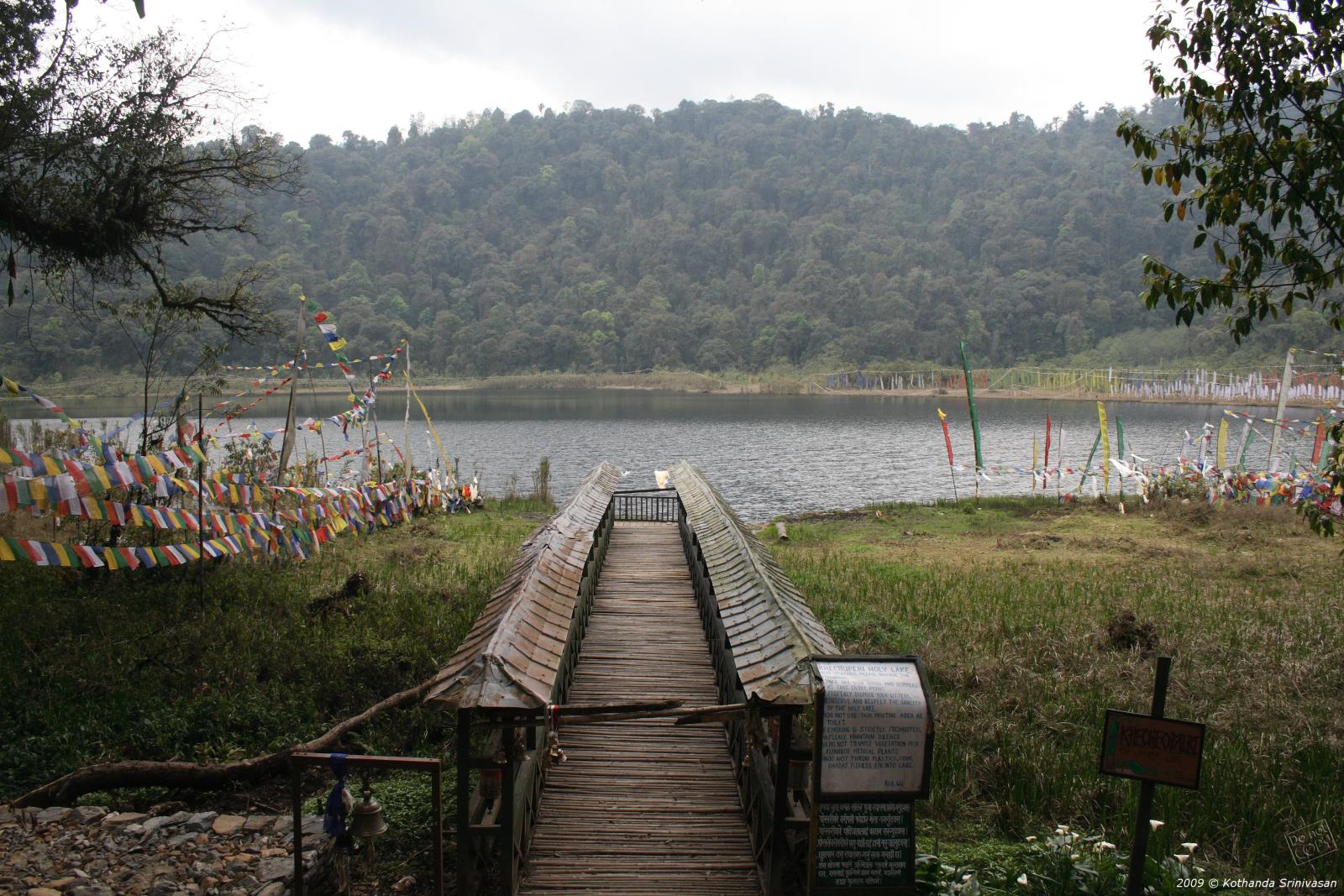
Photo: Kothanda Srinivasan · CC BY 2.0, Wikimedia Commons

In brief

Khecheopalri is a sacred lake at about 1,700 m in West Sikkim, 25–30 km from Pelling, revered by Buddhists and Hindus alike. A short path leads through forest to a prayer-flag jetty on still green water. Most people visit on a half-day trip from Pelling; a night in a village homestay gives you the quiet hours.

The local story

Sho Dzo Sho: the lake that was asked to sit

Long before it had a car park, this lake had a name that sounds like an invitation. Its older name, Sho Dzo Sho, is usually translated as 'O lady, sit here'. The name Khecheopalri itself is often read as Kha-Chot-Palri, 'heaven of Padmasambhava', the Indian teacher whom Sikkim's Buddhists call Guru Rinpoche. The whole surrounding country is part of Demazong, the 'hidden valley of rice' that, in Buddhist tradition, Guru Rinpoche blessed and kept hidden as a refuge for later generations.

The local story about the lake's shape is shared by two faiths. Seen from the ridge above, the outline of the water is said to resemble a footprint. Buddhist pilgrims say it is the footprint of Tara, the female Buddha of compassion; Hindu pilgrims say it is the footprint of Shiva. Both come here to light butter lamps or incense, tie prayer flags and make a wish, which is why it is often called the wishing lake.

The best-known piece of lore is about the trees. Forest grows close around the water, yet people here will tell you that the surface stays clear because birds pick up any leaf that falls on it. Whatever you make of that, the lake is cared for: boating, fishing and swimming are not allowed, shoes come off on the jetty, and visitors are asked to keep their voices low. In the early morning, before the day trippers from Pelling arrive, it is the quietest place on the West Sikkim circuit.

The lake's older name, Sho Dzo Sho, is usually translated as 'O lady, sit here'; Khecheopalri is often read as Kha-Chot-Palri, 'heaven of Padmasambhava'.
Seen from the ridge above, the lake's outline is said to resemble a footprint: of Tara for Buddhist pilgrims, of Shiva for Hindu pilgrims.
Boating, fishing and swimming are not allowed, and local belief holds that forest birds remove any leaf that falls on the water.

About Khecheopalri

The lake lies in a forested bowl below Khecheopalri village, about 25–30 km from Pelling by a road that branches off the route to Yuksom. Cars stop at a small parking area with tea stalls and shops selling incense and prayer flags. From there a paved path of a few hundred metres leads through the trees to a wooden jetty draped with flags, where you look across the water to the forest on the far side. The walk is flat and short enough for seniors and small children.

Most visitors give it an hour on a Pelling sightseeing loop, together with Rimbi Falls and Kanchenjunga Falls. That is fine, but the lake is at its best early in the morning or late in the afternoon, when the cars have gone and the birds are active. If you can, spend a night in one of the simple homestays nearby and walk up to the village and its small gompa. Indians need no permit; foreign nationals need the Sikkim Restricted Area Permit.

What to see and do

The prayer-flag jetty

A wooden walkway runs out over the water under rows of prayer flags. Take off your shoes, walk slowly and stand at the end to look across the lake to the forest. Early morning light, with mist lifting off the water, is the time photographers wait for.

A lake shared by two faiths

Buddhist and Hindu pilgrims both come here, seeing in the outline of the lake the footprint of Tara or of Shiva. You will see butter lamps, incense and prayer wheels side by side. Watch quietly, and if you want to make a wish, light a lamp at the stand.

Khecheopalri village and gompa

Above the lake, the farming village of Khecheopalri has its own small gompa and wide views over the valley. A steady uphill walk or a short drive takes you there. It is where most homestays are, and where you see everyday life beyond the tea stalls.

Birds in the lake forest

The broadleaf forest around the water is good for birdwatching in the quiet hours. Sunbirds, laughingthrushes, minivets and barbets are among the birds people commonly see in forests like this. Bring binoculars and walk the path slowly before 8 am; sightings are never guaranteed.

Waterfalls on the way

The road from Pelling passes Rimbi Falls and Kanchenjunga Falls, both standard stops on a sightseeing loop. They run hardest in September and October after the monsoon. Combine them with the lake for a half-day trip that costs ₹2,500–3,500 for the whole car.

How to get there

Reserved car from Pelling
The simplest way: a Pelling sightseeing car covering Khecheopalri, Rimbi Falls and Kanchenjunga Falls costs about ₹2,500–3,500 for the vehicle, 25–30 km each way and about an hour of driving. Shared by four or five people, it is cheap. Fares are indicative.
Shared jeep
A small number of shared jeeps run between Geyzing and Khecheopalri, usually leaving Geyzing in the afternoon and returning the next morning, roughly ₹100–150 a seat. That timing suits travellers staying overnight. Check current timings at the Geyzing stand or with your hotel.
On foot from Yuksom
An old footpath links Khecheopalri with Yuksom over the forested ridge, and some trekkers walk it as part of a monastery trail. It takes most of a day. Go only with a local guide (₹1,500–2,500 a day), ask about trail conditions, and avoid it in the monsoon.

Where to stay

There are no hotels at the lake, only a handful of simple homestays and lodges near the parking area and in Khecheopalri village on the ridge above. Expect ₹1,500–2,500 per person with dinner and breakfast, home-cooked food, shared bathrooms in some places and very cold nights from December to February. Electricity and hot water can be irregular, so carry a torch and warm layers. If you prefer more comfort, stay in Pelling, 25–30 km away, and visit on a half-day trip, coming early in the morning to beat the crowds.

Local tips

  • Reach the lake before 9 am or after 3 pm to avoid the busiest hours of the Pelling sightseeing cars.
  • Take off your shoes on the jetty, walk clockwise around prayer wheels and do not throw coins, food or flowers into the water.
  • Carry a light rain jacket even in clear months, because cloud often settles in the lake bowl by midday.
  • If you stay overnight, bring a torch and warm clothes; homestay power and hot water can be irregular.
  • Combine the lake with Rimbi Falls and Kanchenjunga Falls in one car to split the ₹2,500–3,500 fare among more people.

On the map

Khecheopalri and its neighbours

Map of Khecheopalri, Pelling, Yuksom, TashidingIndiaChinaNepalKhecheopalri1KhecheopalriPelling2PellingYuksom3YuksomTashiding4Tashiding10 kmN
  1. 1Khecheopalri
  2. 2Pelling
  3. 3Yuksom
  4. 4Tashiding
Drawn by Darjeeling Himalayas from Natural Earth outlines (public domain). Borders as depicted by India. Not for navigation.

Close by

Nearby places

Pelling
hill station2,150 m Pellingपेलिङ Kanchenjunga at dawn above the monasteries of old Sikkim
Yuksom
village1,780 m Yuksomयुक्सम Sikkim's first capital and the trailhead for Goecha La
Tashiding
monastery town1,465 m Tashiding The heart-shaped hill of the sacred Bumchu vase

Ways to travel

Questions people ask

Questions about Khecheopalri

How far is Khecheopalri Lake from Pelling?

About 25–30 km, roughly an hour each way by car on a road that branches off the route to Yuksom. Most people visit on a half-day loop that includes Rimbi Falls and Kanchenjunga Falls, costing ₹2,500–3,500 for a reserved car. A few shared jeeps run from Geyzing, mostly in the afternoon.

Is Khecheopalri Lake worth visiting?

Yes, if you come at the right time. In the early morning or late afternoon it is one of the quietest and most beautiful spots in West Sikkim, with a prayer-flag jetty over still water and forest all round. At midday in October it can be crowded with groups, so time your visit to avoid the rush.

Why is it called the wishing lake?

Buddhist and Hindu pilgrims both believe that prayers and wishes made here are heard. Buddhists link the lake to Guru Rinpoche and Tara, and Hindus see Shiva's footprint in its outline. Pilgrims light butter lamps, tie prayer flags and make a wish at the jetty. Visitors are welcome to do the same, quietly.

Is there an entry fee at Khecheopalri Lake?

A small entry or parking fee has usually been charged, in the range of ₹10–50, and you may spend a little more on butter lamps or prayer flags. Fees change, so check current rates at the gate. There is no charge for walking the path to the jetty once you are in.

What is the best time to visit Khecheopalri?

October to December and March to May are best, with dry paths and clearer skies. Winter mornings are cold and often misty over the water, which many photographers love. June to September brings heavy rain, leeches and landslides on the road. At any time of year, come early in the day.

Can we stay overnight at Khecheopalri?

Yes, in a handful of simple homestays and lodges near the lake and in the village above, at about ₹1,500–2,500 per person with dinner and breakfast. Facilities are basic and winter nights are cold. An overnight stay lets you see the lake at dawn before the day trippers, which is the main reason to do it.

Do foreigners need a permit for Khecheopalri?

Foreign nationals need the Sikkim Restricted Area Permit, which covers Pelling, Yuksom and the lake. It is issued online or at entry points such as Rangpo and Melli. Indians do not need any permit. Carry passport and visa copies, and check current status before you travel, as rules change.

What should we wear and do at the lake?

Dress modestly, carry a warm layer and a rain jacket, and wear easy-to-remove shoes because they come off on the jetty. Walk clockwise around prayer wheels, keep your voice low, and do not throw coins, flowers or food into the water. Ask before photographing pilgrims at prayer.

Can we combine Khecheopalri with Yuksom in one day?

Yes. Khecheopalri lies off the Pelling–Yuksom road, so a reserved car can do Pelling, the falls, the lake and Yuksom in one long day for about ₹3,000–4,000. Better still, visit the lake on your way to a night in Yuksom, so you are not racing back to Pelling before dark.

Plan with a local

Tell us your dates. We send the real cost

Where you want to go, how many of you, and roughly what you want to spend a day. A planner who lives in these hills replies within one working day with a route and every rupee written down.

  • No payment to start
  • Shared jeep or private car, your choice
  • Homestays we have slept in
  • Change anything, any time before you book

Get a priced route

Within one working day. No payment to start.

We reply by email or WhatsApp. See our privacy policy.

Plan Khecheopalri