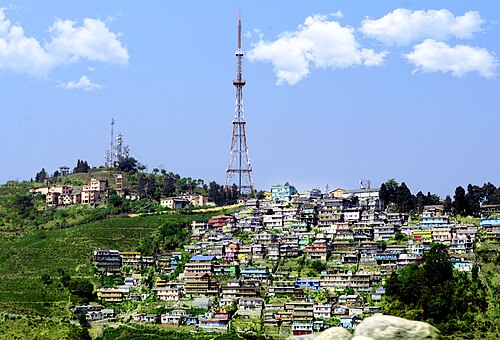
The story of Kurseong & Mirik
The middle hills between the plains and Darjeeling
Kurseong was hill country that changed hands more than once before the British arrived. Nepal's Gorkha armies took the area around 1780; the Treaty of Titalia in 1817 handed it back to Sikkim; and from 1835, when the East India Company took the Darjeeling tract as a sanatorium, the slopes below Darjeeling were opened up for roads, tea and schools. Kurseong became a municipality in 1879, the same decade the Darjeeling Himalayan Railway was being pushed up the hill, and a subdivision in 1890.
Tea shaped everything after that. Makaibari, just below Kurseong, commissioned its factory in 1859, and the Banerjee family ran the estate for four generations. West of the Balason river, Nepali sardars and later planters cleared the Mirik valley: Soureni's tea was formally established in 1902, and Gopaldhara traces its first planting to 1881. The workers who came from eastern Nepal brought Nepali, which is still the language of these hills, alongside the older Lepcha place names.
The twentieth century left its own marks. Subhas Chandra Bose was held under house arrest in his brother's house at Giddapahar in 1936. A Jesuit seminary taught on St Mary's Hill from 1889 to 1971. In the 1970s a marsh at Mirik was turned into Sumendu Lake, opened in 1979, and Tibetan Buddhist teacher Bokar Rinpoche founded his monastery above it in 1984. Today the land lives on tea, oranges, schools and small-scale tourism.