The local story
The ridge that guarded Sikkim's royal court
Pelling itself is a young town, most of its hotels built in the last few decades on what was a farming ridge above Gyalshing. The ground around it is old. In 1670 Tensung Namgyal, the second Chogyal (king) of Sikkim, moved his court from Yuksom to Rabdentse, a forested spur a short way below today's town. For almost a century and a half the kings ruled from there, until raids by the Gorkha armies of Nepal made the site unsafe, and in 1814 the capital moved east to Tumlong. What remains is a set of stone walls, chortens and terraces among the trees, now a protected monument.
On the hill above the ruins, Pemayangtse Monastery was founded around 1705 in the line of Lhatsun Chempo, one of the three lamas who crowned the first Chogyal at Yuksom in 1642. The name means 'perfect sublime lotus'. It follows the Nyingma school, and for generations it held a special place at court: its head lama anointed the Chogyals, and its monks were traditionally drawn only from Bhutia families of 'pure' lineage, called ta-sang. On its top floor sits Zangdok Palri, a seven-tiered painted wooden model of Guru Rinpoche's heavenly palace, carved by Dungzin Rinpoche over about five years.
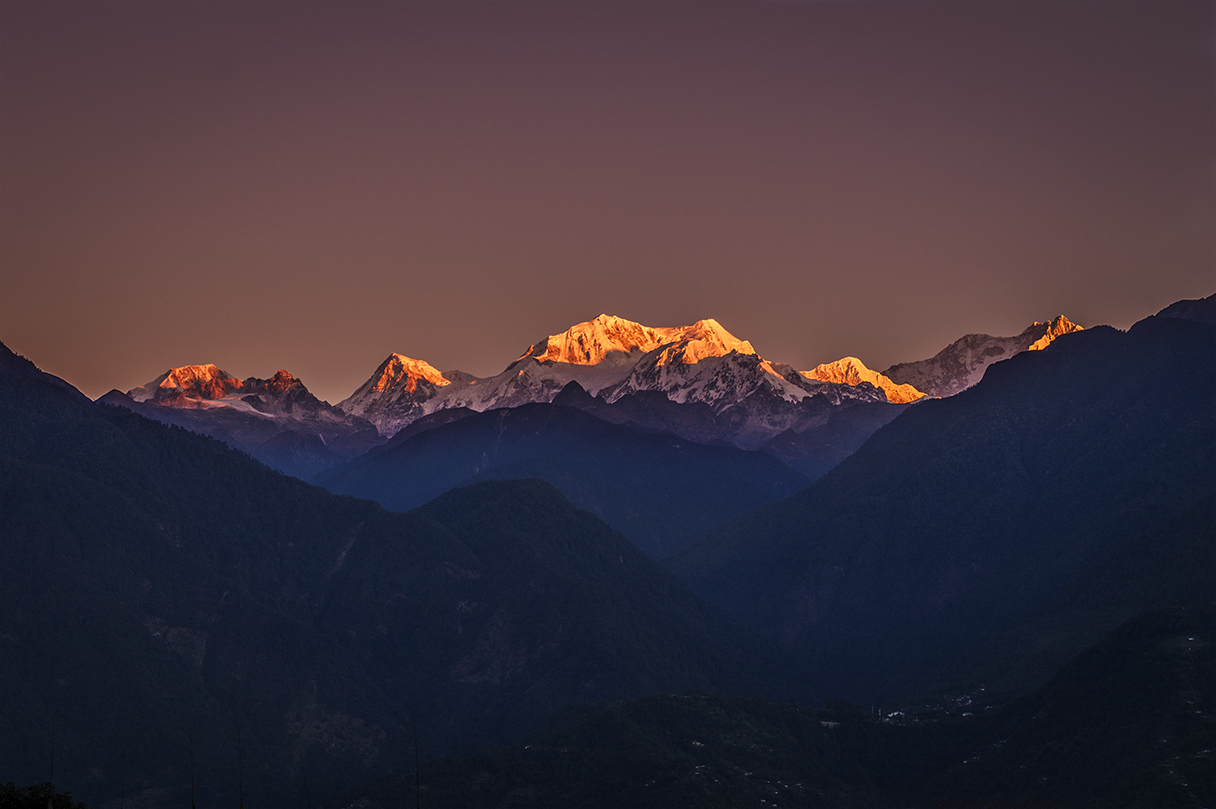
Higher on the same ridge, Sanga Choeling Monastery is dated to 1697 and counts among the oldest in Sikkim. Its view explains why this ridge mattered: straight across the valleys stands Kanchenjunga, 8,586 m, which the Lepcha and Bhutia people of Sikkim honour as a guardian deity. In 2018 a tall Chenrezig statue and a glass skywalk opened on the hill, and a new kind of pilgrim, the phone photographer, now walks up beside the monks. We like Pelling best at 5.30 am, when the town is quiet and the mountain turns pink before the shops open.


