DarjeelingHIMALAYAS
Jaldapara National Park

The Dooars & Siliguri · national park

Jaldapara National Park

India's second rhino stronghold, on the Torsa

Altitude61m Nights2 BestNov – Mar

Photo: JKDs · CC BY 2.0, Wikimedia Commons

In brief

Jaldapara is a 216 km² park of tall grassland and riverine forest on the Torsa, with around 330 one-horned rhinos, the largest population in India after Kaziranga. Jeep safaris start from Madarihat; elephant safaris run when the forest department allows. Closed mid-June to mid-September.

The local story

A rhino refuge on the Torsa since 1941

Before the British, this was the country of the Toto and the Mech, and of the Bhutanese duars that controlled the passes. After 1865 it became part of the British Western Duars, and by the early 20th century hunting and the spread of tea gardens had pushed the one-horned rhino in north Bengal close to the edge. Jaldapara was declared a sanctuary in 1941, specifically to protect the rhino, and became a national park in 2014.

The rhino came back. The forest department's March 2025 count estimated about 331 animals, up from 287 in the previous estimate, making Jaldapara the second rhino stronghold in India after Kaziranga. The park also holds elephants, gaur, sambar, hog deer, leopards and a rich grassland bird life.

For decades the heart of a Jaldapara visit was Hollong, a wooden forest lodge deep in the park beside a salt lick, where guests woke to rhinos and elephants below the veranda and elephant safaris set out at dawn. On 18 June 2024, with the lodge closed for the monsoon, a fire gutted it. Then in October 2025 floods on the Torsa and its tributaries damaged roads and bridges and closed the park for a time. Check current status before you travel.

The March 2025 count estimated about 331 rhinos in Jaldapara, roughly five times Gorumara's 61, both counted on 5–6 March.
Hollong, the three-storey wooden forest lodge inside Jaldapara, was gutted by fire on the night of 18 June 2024 while closed to tourists for the monsoon.
During the October 2025 floods, forest department kunki elephants ferried stranded tourists across floodwater after a wooden bridge to a forest lodge in Jaldapara collapsed.

About Jaldapara National Park

Jaldapara is flatter and wilder-feeling than Gorumara. Tall elephant grass stands higher than a jeep, with patches of riverine forest and the braided channels of the Torsa and its tributaries running through. Rhinos graze in the open grass in the early morning, peafowl strut on the tracks, and elephants appear without warning out of the reeds.

Madarihat, the small town on the highway at the park's western edge, is the base, with the forest office, safari counters, the WBTDC lodge and private hotels. Two nights give you two safaris. Use the spare hours for Totopara, home of the Toto community, the Chilapata forest and its ruins, or a drive through the tea gardens of Birpara.

What to see and do

Dawn jeep safari in the grassland

The first jeep slot runs into tall grass and riverine forest when rhinos are out grazing. Watch for them at the edges of the grass and in wet hollows.

Elephant safari, when offered

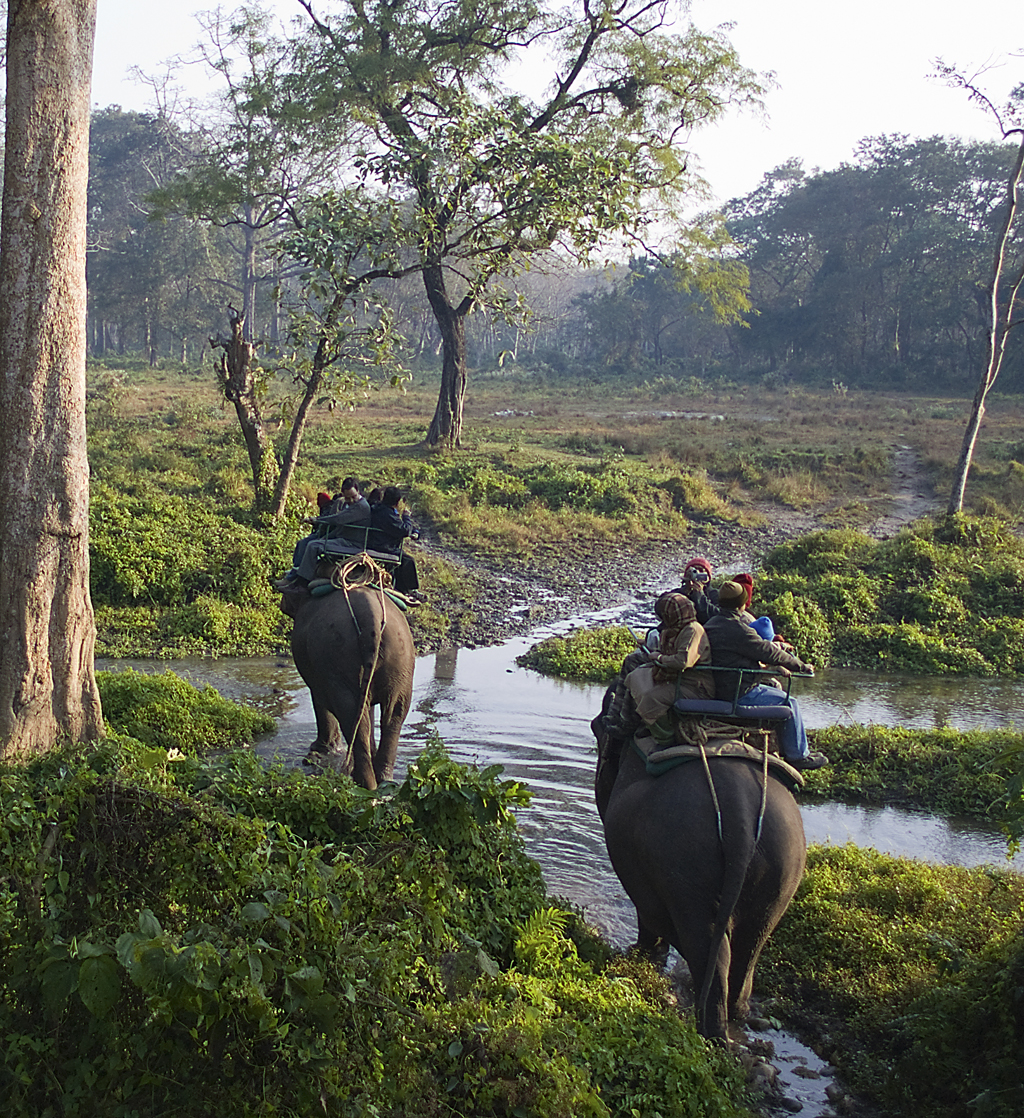
Riding into the grass on a forest department elephant brings you closer to rhinos than any jeep. It runs only when the department allows; check before you plan around it.

Totopara and the Toto community

About 22 km away, near the Bhutan border, Totopara is home to the Toto, a community of about 1,600 people with their own language, now written in its own script since 2015.

Chilapata's ruins

East of the park, the Chilapata forest hides the brick ruins of Nalraja Garh, linked by archaeologists to an early frontier fort. A safari can include them.

Grassland birds

Jaldapara's grasslands hold birds that are hard to find elsewhere in Bengal, including Bengal florican in some years, along with hornbills, raptors and many waterbirds.

Tea gardens of Birpara

Flat gardens with tall shade trees spread west of Madarihat. A morning drive shows the plains tea that made the Dooars rich.

How to get there

Reserved car
From NJP or Bagdogra about 125–135 km via Malbazar, Chalsa and Birpara, three and a half to four hours, ₹4,000–5,000.
Train
Dooars line trains from NJP or Siliguri Junction stop at Madarihat or Hasimara; four to five hours. Check the current timetable, then an auto or car to your lodge.
Bus
Buses for Alipurduar, Falakata or Cooch Behar via Birpara pass Madarihat; ₹150–250, about five hours.
From Lataguri
About 80–90 km, two to two and a half hours by car, ₹3,000–3,500.

Where to stay

Madarihat has the WBTDC Jaldapara Tourist Lodge, a handful of private hotels and resorts on the highway, and homestays in the villages around, from about ₹1,500 to ₹4,000 a room. The forest corporation's small Mendabari Jungle Lodge and Malangi Lodge lie on the Chilapata and Kodalbasti side. Hollong, the old lodge inside the park, burned in June 2024; do not book anything claiming to be Hollong unless the forest department confirms it has reopened.

Local tips

  • Book jeep safari slots online with the forest department as soon as your dates are fixed; winter weekends sell out.
  • Take the first morning slot; rhinos graze in the open grass before the heat.
  • Ask at the Madarihat forest office whether elephant safaris are running before you plan around them.
  • Totopara is a community, not a sight; go with respect and ask before photographing anyone.
  • Parks close from about 16 June to 15 September, and the October 2025 floods closed Jaldapara for a time; check current status before you travel.

On the map

Jaldapara National Park and its neighbours

Map of Jaldapara National Park, Chilapata, Buxa, Jayanti, LataguriIndiaBhutanBangladeshJaldapara National Park1Jaldapara National ParkChilapata2ChilapataBuxa3BuxaJayanti4JayantiLataguri5Lataguri25 kmN
  1. 1Jaldapara National Park
  2. 2Chilapata
  3. 3Buxa
  4. 4Jayanti
  5. 5Lataguri
Drawn by Darjeeling Himalayas from Natural Earth outlines (public domain). Borders as depicted by India. Not for navigation.

Close by

Nearby places

Chilapata
forest village80 m Chilapata An elephant corridor with a ruined fort inside
Buxa
trek stop867 m Buxaबक्सा A Bhutanese fort, a British prison, a Tibetan refuge
Jayanti
forest village200 m Jayantiजयन्ती A wide white riverbed under the Bhutan hills
Lataguri
forest village100 m Lataguri The highway village at Gorumara's gate

Routes

Festivals

Ways to travel

Questions people ask

Questions about Jaldapara National Park

How many rhinos are in Jaldapara?

The forest department's March 2025 estimate was about 331 one-horned rhinos, in a range of 327–334, up from 287 in the previous count. That makes Jaldapara the largest rhino population in India after Kaziranga. The October 2025 floods may have changed numbers slightly.

When is Jaldapara National Park closed?

Every monsoon, usually from 16 June to 15 September. The park was also closed for a time after the October 2025 floods damaged roads and bridges. Check current status with the forest department before you travel.

Is Hollong lodge open?

Hollong, the wooden forest lodge inside Jaldapara, was gutted by fire on 18 June 2024. Reports have discussed rebuilding, but we have not confirmed that it is open again. Do not book any property advertised as Hollong without confirming with the forest department.

Where should I stay for Jaldapara?

Madarihat, at the park's western edge, has the WBTDC Jaldapara Tourist Lodge, private hotels and homestays from about ₹1,500 to ₹4,000 a room. On the Chilapata side, the forest corporation's Mendabari and Malangi lodges are quieter. Hasimara has a few budget hotels near the station.

How much does a Jaldapara safari cost?

A six-seat jeep with entry, guide and fees costs roughly ₹2,500–4,000 for Indian visitors in 2025–26, or about ₹450–700 a seat when shared. The elephant safari, when running, is about ₹800–1,000 per person for Indians. Rates change often.

How many days are needed for Jaldapara?

Two nights is ideal: one evening and two morning safaris, or a safari plus Totopara or Chilapata. Add a night for Buxa or Jayanti, an hour or two east. One night with a single safari is possible but rushed.

Is Jaldapara better than Gorumara?

For rhinos, Jaldapara is larger with about five times as many. Gorumara is closer to Siliguri and uses watchtowers. Doing both on a four-night trip is the classic Dooars plan.

Can foreigners visit Jaldapara?

Yes. Foreign nationals pay higher entry and safari fees and must show passports. No special permit is needed for Jaldapara itself. Totopara and areas near the Bhutan border may involve ID checks; carry your passport.

What is the best time to visit Jaldapara?

November to March, when grass is shorter after burning and cutting, mornings are cool and animals are easier to see. March and April are good for rhinos but hotter. October can be wet and the grass tall.

Plan with a local

Tell us your dates. We send the real cost

Where you want to go, how many of you, and roughly what you want to spend a day. A planner who lives in these hills replies within one working day with a route and every rupee written down.

  • No payment to start
  • Shared jeep or private car, your choice
  • Homestays we have slept in
  • Change anything, any time before you book

Get a priced route

Within one working day. No payment to start.

We reply by email or WhatsApp. See our privacy policy.

Plan Jaldapara National Park